

Harajuku Girls Co-opted
Back to Contents of Issue: June 2005
|
|
|
|
by Emily Kubo |
|
 Japanese
pop culture has always commanded a cultish following -- its anime/manga, video
games, Pokemon, and Hello Kitty are enjoyed all over the world. But now, Americans
have also discovered something else that intrigues them -- the Harajuku girls. Japanese
pop culture has always commanded a cultish following -- its anime/manga, video
games, Pokemon, and Hello Kitty are enjoyed all over the world. But now, Americans
have also discovered something else that intrigues them -- the Harajuku girls.
The Harajuku girls, done up in bizarre outfits and makeup, hang out in Tokyo's fashionable Harajuku district. Previously little known outside of Japan, they rose to fame when the lead singer of Ska/punk band "No Doubt," Gwen Stefani, featured them in her recent solo debut album: Love. Angel. Music. Baby. A fashion icon who is often seen in kooky outfits, trademark platinum blond hair and engine-red lipstick, Stefani claims these adolescent girls as the muses for her entire album, as well as for her own fashion line, L.A.M.B. The singer's video from her first single "What Ya Waiting For?" is shot with a distinct Japanesy flair, supplemented by four black-liquid eye-lined, pig-tailed, and cherry-lipped "Harajuku girls" prancing around in clothes by Vivian Westwood. In a recent Marie Claire interview, Stefani says the idea of using Japanese girls as backup dancers came to her in a dream. These so-called Harajuku girls appear throughout the album, even in songs that have no apparent relation to them. The album also includes a song titled in the girls' honor, in which Stefani professes, "Harajuku girls, you got the wicked style -- I like the way that you are -- I am your biggest fan, oh." As if video appearances were not enough, Stefani also has Harajuku girls trailing after her for appearances in promotional and red carpet events. During interviews, the entourage sit behind the singer with studied disaffection, and alter their facial expressions and shift around periodically, although always seemingly on cue. When asked about them during an interview on MTV, she replied, "Can you even see them? I mean, are they even there?" claiming they are a figment of her imagination. Rumor has it that Stefani's posse are under contractual obligation to converse only in Japanese in public, thus adding to their foreign allure, although in real life they are plain-Jane American girls who speak perfect English. Bystanders argue vigorously on Internet message boards whether Stefani's adoration of the girls is super cool or an atrocious act of cultural hijacking. Although some love the concept, others feel that the singer is exploiting a subculture by packaging the girls a la Hollywood and marketing them to the mainstream. In fact, various web sites/blogs have sprung up that dedicate themselves to the discussion of these four faux harajuku girls, named Angel, Love, Music, and Baby after her album title. In one blog, the author has taken up this controversy as a cause by selling FTG4 ("Free the Gwenihana Four") T-shirts and mugs in order to rescue "the pseudo harajuku girls" from "serving an unspecified term in the custody of pop singer Gwen Stefani." "For freedom!" the blogger chants. Although such websites are obviously tongue-and-cheek (surely the girls are well-paid for their odd job), there is no doubt that Stefani's new album and subsequent publicity stunts have pushed the previously obscure Harajuku fashion into the forefront of American pop culture. When asked about this recent trend, Rachel Dodes, a 27-year-old journalist and a New York native says: "Harajuku girls? They are so hot here! I think a gaggle of Japanese girls is the next Louis Vuitton handbag -- the ultimate accessory." Harajuku girls, like sushi restaurants, have become another cool Japanese cultural export and yet another addition to the image of 'Japan Cool'. But who are the real Harajuku girls, the true girls that inspired an American pop singer to exalt them to the point of obsession? 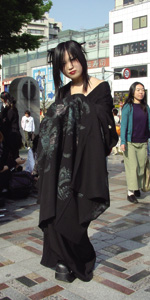
Harajuku as a Fashion Mecca Before the Olympic Games came to Tokyo, Harajuku was little more than a quiet residential neighborhood, only just recovered from the destruction of World War II. It came into its own, however, in 1964, after the government converted a stretch along Omotesando into an Olympic Village for the athletes. The games brought a slew of foreign visitors, which stamped the once-sleepy town with a cool, modern image. Harajuku remains THE district of fashion. Although the word Harajuku has only spelled fashion for Westerners in recent years, it has, in fact, been a trendsetter for over 30 years. In the 1970s, fad cultures here exuberated a more rebellious streak. The original place of congregation was inside Harajuku's Yoyogi Park, where up until the early 80s hip youngsters called the Takenozoku on Sundays engaged in such delinquent behaviors as smoking cigarettes, greasing their hair, and dancing. They symbolized youth decadence and rebellion (even documented by an NHK program). In the mid-1980s, however, dancing, cigarette-touting youngsters gave way to the "bando-zoku," amateur bands who gathered to showcase their talent. Yoyogi Park became an expo of street bands from all over the country and was the birthplace of some of the most popular bands in Japan. Harajuku Today 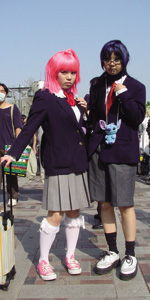
 Harajuku remains a mecca for the young and fashion conscious. Its nature, however,
has taken a turn for the innocuous. For example, to the left of Harajuku Station
lies Tokyo's answer to the avenue of the Champs-Elys's, the wide tree-lined Omotesando-dori,
home to very adult and mostly high-end brands such as Gucci, Armani, and Burberry.
It also sports Japan's largest Louis Vuitton store, in front of which begin queues
that wind down several streets whenever a new handbag or limited edition item
is launched. Venturing into the side streets of Omotesando, however, you find
the equally famous Takeshita-dori, a narrow road only 440 meters long. This "dori,"
or street, is a breeding ground for young fashion and particularly attuned to
the capricious nature of trends, testified by the furious pace in which new shops
replace old ones. On weekends and holidays, the road is packed with tourists,
locals, and fashion-conscious youngsters alike, making it difficult at times to
stroll in a straight line.
Harajuku remains a mecca for the young and fashion conscious. Its nature, however,
has taken a turn for the innocuous. For example, to the left of Harajuku Station
lies Tokyo's answer to the avenue of the Champs-Elys's, the wide tree-lined Omotesando-dori,
home to very adult and mostly high-end brands such as Gucci, Armani, and Burberry.
It also sports Japan's largest Louis Vuitton store, in front of which begin queues
that wind down several streets whenever a new handbag or limited edition item
is launched. Venturing into the side streets of Omotesando, however, you find
the equally famous Takeshita-dori, a narrow road only 440 meters long. This "dori,"
or street, is a breeding ground for young fashion and particularly attuned to
the capricious nature of trends, testified by the furious pace in which new shops
replace old ones. On weekends and holidays, the road is packed with tourists,
locals, and fashion-conscious youngsters alike, making it difficult at times to
stroll in a straight line.
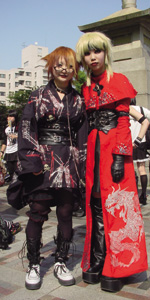
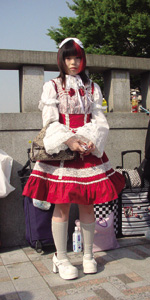
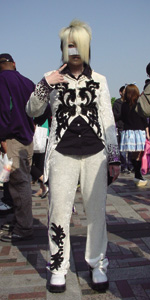
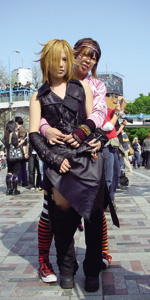
As for the bando-zoku, in 2003 residents who were fed up with the noise and general mayhem cracked down on the Sunday jams in Yoyogi Park. This was not enough to stop Harajuku from being a showcase town, however. The young people today have moved just outside the park, onto Jingubashi bridge, near the station at the entrance of Meiji Shrine. Although bands occasionally play on Jingubashi, today the bridge mainly serves as the meeting place for the "Harajuku girls." (This particular area is no longer officially Harajuku, since it was changed to Jingu-Mae, but locals still refer to the vicinity of the bridge by its old name.) Unlike the wannabes in Hollywood, these girls are the real thing, easily spotted by their eye-popping, over-the-top clothes. They dress in Halloween-like costumes, don outrageous makeup, and hang around on Sundays, not doing much besides socializing with their equally out-rageously clad peers and occasionally posing for the incredulous tourists or photojournalists. Some of the girls live hours away, but take the train in every week just to be seen. "It makes me feel free," says Kuren, who makes her own cosupure (costume play) outfits. On most days, the girls wear school uniforms, and only on Sundays when they come here do they blatantly express their style and personality. Although initially bewildering, the fashions, you find, follow guidelines, and almost all the girls place themselves in a certain genre. There are (gasp!) rules, despite the superficial craziness. A well-documented style amongst these young girls is Gothic Lolita, or Goth Loli (gosurori). It has the look of a gothic Victorian baby-doll -- combining the look of Lolita fashion (deliberate cuteness and contrived innocence), with certain gothic styles. According to Wikipidea, this particular look emerged as a youth subculture around 1997 - 1998 and became a well-established genre in Japanese department stores circa 2001. 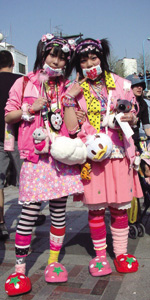 There are variations of the Gothic Lolita look. One is the more feminine "Classic
Lolita" (more traditional, girlish clothing), and the most common is called "Elegant
Gothic Lolita" (EGL). The EGL style is well known among fans of bijuaru kei (visual
style) bands, a form of Japanese rock music in which musicians perform in elaborate
costumes. The physical peculiarities of the EGL look were popularized by Mana,
the cross-dressing leader of the now disbanded Malice Mizer group. He coined the
term EGL and Elegant Gothic Aristocrat (EGA, for men who like to dress up in the
Victorian style), which he used to describe the fashion of his own label, Moi-meme-Moitie.
The standard "dress code" is usually short (above the knee), puffy and lacy, worn
with knee-high tights or fishnet stockings. Classic Lolitas, on the other hand,
prefer longer dresses with more feminine designs and do not shy away from carrying
stuffed animals or wearing straw hats and bonnets. EGAs usually wear lots of black,
red, and white. They sometimes carry small props in the shape of coffins, bats,
and crucifixes. A not-yet-documented genre of the Gothic look is called "punk
goth." As the name suggests, this style is more punk and less rule bound (many
wear pants instead of skirts).
There are variations of the Gothic Lolita look. One is the more feminine "Classic
Lolita" (more traditional, girlish clothing), and the most common is called "Elegant
Gothic Lolita" (EGL). The EGL style is well known among fans of bijuaru kei (visual
style) bands, a form of Japanese rock music in which musicians perform in elaborate
costumes. The physical peculiarities of the EGL look were popularized by Mana,
the cross-dressing leader of the now disbanded Malice Mizer group. He coined the
term EGL and Elegant Gothic Aristocrat (EGA, for men who like to dress up in the
Victorian style), which he used to describe the fashion of his own label, Moi-meme-Moitie.
The standard "dress code" is usually short (above the knee), puffy and lacy, worn
with knee-high tights or fishnet stockings. Classic Lolitas, on the other hand,
prefer longer dresses with more feminine designs and do not shy away from carrying
stuffed animals or wearing straw hats and bonnets. EGAs usually wear lots of black,
red, and white. They sometimes carry small props in the shape of coffins, bats,
and crucifixes. A not-yet-documented genre of the Gothic look is called "punk
goth." As the name suggests, this style is more punk and less rule bound (many
wear pants instead of skirts).
In a society that extols female youth, it is not surprising that the philosophy of gosurori -- which incorporates the innocent and the alluring (or angel and devil in one body, in direct Japanese translation) -- is appealing to certain older men. "It's totally sick, seeing these old men hanging around young girls and taking pictures of them," says Rivena Ridikir, a pretty 24-year-old blond from Germany and a self-confessed manga enthusiast who studies Japanese at Sophia University. "These guys obviously have a fetish or something." Rivena and her American friend Jamie are two of a handful of foreigners in outrEoutfits (which they claim is everyday wear). When asked what brought them to Jingubashi bridge, Rivena replied, "I am just here to look around myself, and to take some pictures. I love their styles. I think they are wonderful -- and I hate how the West is now taking this totally underground thing and making it commercial." Jamie adds, "Back home I was one of the few people who dressed this way, so sometimes I make the clothes myself and sell them on the Internet." Although entrepreneurial sounding, Jamie was quick to dismiss the suggestion that she is anything about business: "Oh no, I hate capitalism and all of that." Another genre popular among young girls is cosupure, a portmanteau of "costume" and "play." This subculture's participants dress as their favorite characters from manga, anime, video games, and Japanese pop music bands. At Harajuku the cosupure girls usually like to imitate an idol from a favorite band, although maid costumes are particularly popular amongst manga fans elsewhere in Tokyo, such as geek central, Electric Town in Akihabara, spawning cafes where young waitresses dressed as maids serve a mostly male clientele. Kuren, aged 15, sports a hand-sewn costume modeled after the look of members in "Dir en Grey," another prominent J-punk Rock band. She travels over an hour and a half from Saitama to join a friend who makes a three-and-a-half-hour trip from Nagano by express bus. Although this is purely a recreational activity for most, their dedication indicates the seriousness with which they approach their Sunday outings. Two Goth Loli girls, Higurakiyo and Kirio, have been coming to Harajuku for two years. Like many other girls, they shop at Takeshita-dori boutiques and then re-arrange the clothes to their own liking. "My parents have already given up," says Higurakiyo, who, at age 22, is clearly more mature and articulate than the younger members of the mini-community. "The only thing they ask is that I don't hang around our neighborhood dressed like this." "My parents don't say anything really," says her 17-year-old companion, Kirio. Others are not so fortunate. "My parents don't know," confesses Tatsu, an adorable 15-year-old Tokyo native, who can easily pass for 12 or 13 in a pink and white lacey Lolita-style dress, complete with a white lacey parasol. "I put my clothes in a bag and I change outside. It's impossible to give up dressing this way because I really love doing this." Her plight is not unusual; a common sight near Harajuku Station is a Lolita or Goth toting a small luggage bag. Unlike the Takenozoku in the 70s, these young girls usually do not have any political agenda or any subversive intent. "I enjoy it. It's just for fun," says Uga, a cheerful, outgoing goth-punk girl. Mekiri agrees. "It's my hobby," she says as both girls join friends for a group photo. The Revisionist and the Real Harajuku Girls Spend an afternoon at Harajuku and you observe a gap between the Hollywood view of Harajuku girls -- rebellious, underground, subversive, rule-breaking - and what is really going on in the streets of Tokyo. Harajuku girls are orderly and have their own rules. Their fashion has its commercial aspects, with widely recognizable brands, and fans can purchase the styles at on-line or brick-and-mortar stores. And although the girls look drastically different from their typical peers, within their own subculture they follow specific fashion rules and guidelines. True, they are not your average teenage delinquents by any means -- these girls display themselves in an orderly fashion and are neither loud nor disturbing. The Harajuku girls do not share Rivena's and Jamie's distaste for capitalism and mainstream culture; if you asked their feelings about capitalism, you would likely elicit blank stares and giggles. From Jingubashi bridge, the average Harajuku girl probably goes home, changes, and eats dinner with her family. She will most likely grow up to be a perfectly respectable adult. Fashion is merely a way for the girls to express themselves in a conformist society, although in doing so they inadvertently follow another set of rules. Although the names of their styles might differ, one thing all the interviewees had in common was that none of them had ever heard of Gwen Stefani, nor did they have any clue that their style is being popularized abroad. When told that they were the inspiration for a popular singer in the US, they were visibly excited. "We are very happy," the girls squealed in unison. "I think American women are attractive, so this type of fashion would look good on them," added one girl. The girls I spoke to seemed aloof from a distance, but were, in fact nice, polite, vivacious teens who enjoy dressing as they do. Everyone imposes their own interpretation on the Harajuku girls - sees them through their tinted lenses. Gwen Stefani, like the rest of us, takes in what she sees in them and loves them for it. Pure love or old-fashioned Orientalism? Visit the Inter-net message boards for the debate. JI |
|
Note: The function "email this page" is currently not supported for this page.
Magazine
For more magazine articles refer to our archives or view all magazines cover pages.
Tags



"To buy a sponsored link please send an email to info@japaninc.com"


Recent Comments
Employment in Japan
you don't understand at all
designboom article
Wow! - many thanks!
Property sites
Currencies
1 USD = 155.54 JPY
1 NZD = 92.72 JPY
1 AUD = 101.47 JPY
1 EUR = 166.86 JPY
1 GBP = 194.62 JPY
04/26/24 12:24 JST
1 NZD = 92.72 JPY
1 AUD = 101.47 JPY
1 EUR = 166.86 JPY
1 GBP = 194.62 JPY
04/26/24 12:24 JST